-
Translations of 박용철
There are very few writers in my life. My mother and father read, but do not write. I have no siblings who enjoy it. In my kaleidoscopic family scattered across continents, we do not share even the one thing in common.
But I do have someone. He is from the past, from before I was born. My great-grandfather was a poet. He passed away when he was 35 from tuberculosis.
Many of his poems were about life and death, and I recall my grandfather saying of his works, he would surely die sooner after reading them. “He only talks about birds. He only talks about dying, and looking up at the sky and the birds and wondering when he’s going to join them.”
It is beautiful, though, to read of beauty, whether of death or life. And it is nice to read something old and foreign, amidst the ever-variant worlds of today.
His originals: https://drive.google.com/file/d/11mo7n8I6LYgr-GHwCK3AkKm_VxehjdZ5/view?usp=share_link
My translations: https://drive.google.com/file/d/1hbOzXgX6TX7xydxn4Ozt9aLQJU-H5agI/view?usp=sharing
-
Blueprints in Translation
In the first week of my internship with RH Korea, I have worked myself a trail of translations: story books, chapter books, poetry, emails. We use language so unconsciously in every other thing we do, but in trying to contextualize meaning in another tongue, language has become enigmatic.
Here are my attempts to pick language apart and piece it back together; and my road to abandoning this method and finding a new source of inspiration altogether.
stage 1: story books
My editor told me very pointedly: translation is not word for word, it is by effect. In one recently released story book, a rabbit finds a magical pogo stick, and garners the catchphrase:
콩! 콩! 콩!
The phrase is onomatopoeic in Korean. It encapsulates the sound of the pogo stick bouncing off the ground, and the action of it. There is no direct translation into English. My solution was:
Hop! Hop! Hop!
It preserves the rhythm; the childlike familiarity; the simplicity. A part of me despairs, nevertheless, that I cannot construe everything about a “콩” in an English phrase. But there is a way, always.
stage 2: poetry
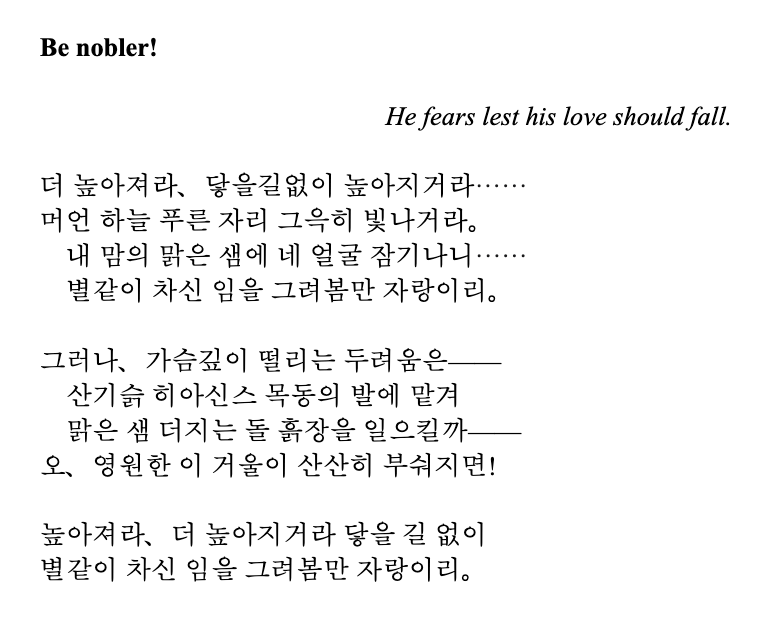
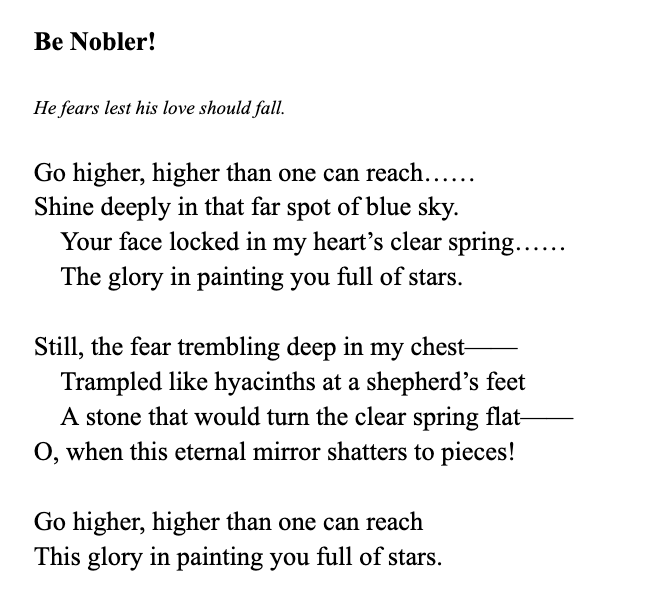
The translation of this one of my great-grandfather’s poems began with less authorly-intuition and much more dictionary referrals. It was immediately easy to tell that it was not a poem. A poem has essence; it has soul. It takes on a life of its own in being written and read, and every direct translation was slowly but surely strangling the poem dry. The result of maintaining this essence could be perceived as inaccurate. But in every sense, I believe it is much more true.
stage 3: creation
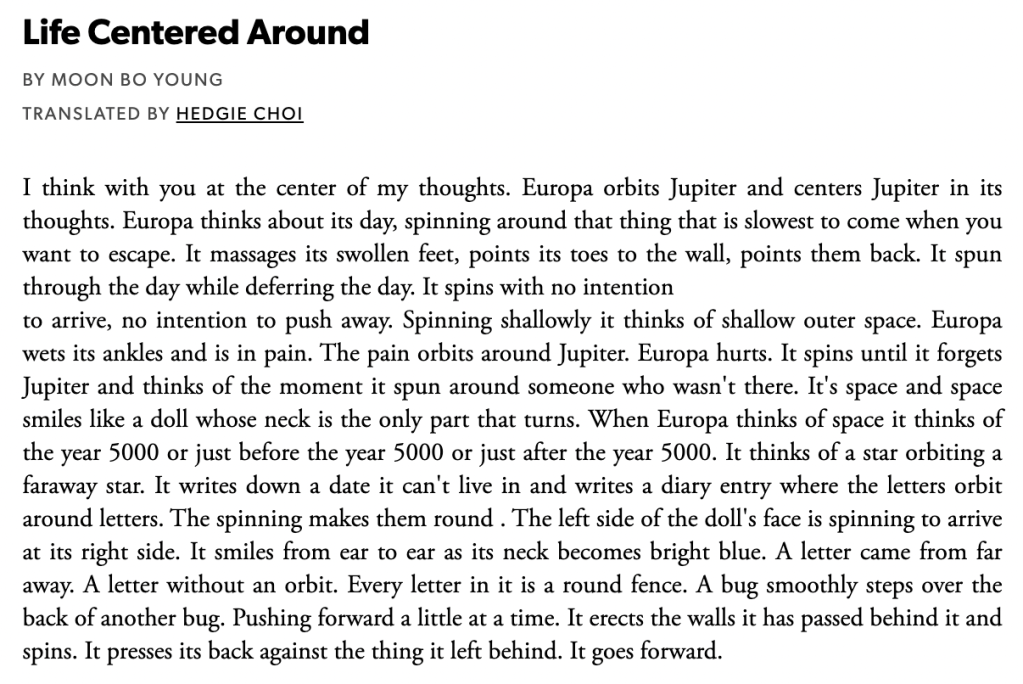
In one of my aimless wandering of the Poetry Foundation archives, I came across this poem. In all my first three readings, I did not realize that this was a translation. There is no hint of hesitance; no drop of fluency. I knew then, without having to have read the original, that Korean cannot read like this, literally. It cannot mean these things. Cannot say these things exactly. The parallelism and anadiplosis Hedgie Choi brings to the very first two lines — “I think with you at the center of my thoughts. Europa orbits Jupiter and centers Jupiter in its thoughts” — is already impossible to replicate with literary aesthetics in Korean. She has very well created a poem of its own. A poem that is the same as its original and yet nothing alike. A child bound by a random string of evolutionary chance, raised by strangers.
-
Summer Prospects
Last summer, I found my absolute favorite novel. The dystopian beauty that is Yōko Ogawa’s The Memory Police enraptured my delight in science fiction, and frankly, literature. It was unreally romantic, twisting, unreal. It is difficult to imagine finding something I could love more than the single pdf of this novel, annotated black at the margins. But this summer, I will try.
I will begin with classics—a somewhat shadowy beast I had escaped by my heels for so long. I am always surprised by how differently people wrote, how differently they lived. I am always wistful, even though I have never lived through those times.
I will save room for translations. Han Kang, Ken Liu, Aoko Matsuda. I expect them to be revolutionary and strange. Harrowing and immiscibly unique, as is always the case with translations. I will read what I do not fully understand, what can never be completely represented in its original form and meanings, in these translations.
I would like to charter a line for screenplays as well. I have not enjoyed reading them as much as watching them acted out, thus far. It is difficult to bring everything to life in my head—is what I tell myself, when I am able to do so just fine with any novel, poem, or line. I would like to try this again. To bring something to life in my own imagination, more than it could ever be by others.
Lastly, I would like something brand new. I do not know yet what to expect. I am going to ask my teachers, my friends, my parents. I could spin a wheel and throw a dart. I do not know what I do not know, but I could always read it. This summer is that time.
-
The Novelty of Nonfiction
From the first age I learned what genres were, I was certain that nonfiction was not my favorite. To me, it seemed impossibly boring. Especially when I had already been charmed by fairy tales and fantasy, any writing from reality seemed all too mundane in comparison.
Admittedly, within a few short years, novels of realistic fiction became my favorites; but even these stories served to hone some grandness in normalcy, an impossibility of unexpectedness that made life all the more fantastical. By right of nonfiction, however, any derivative of imagination was grounded by unyielding fact or truth. I found spectacularly little allure in a story relaying reality, and would continue to believe so until reading this one vignette:
My first thought at thirteen-years-old was that I had never read anything so achingly, baringly beautiful. The passage is from Sandra Cisneros’ novel The House on Mango Street. Today, her novel is one of my favorites, but “Sire” was my first and forever inspiration for creative nonfiction. The mood is incredibly tense, and palpably so. The intrigue and tantalization of her suppressed desire is unnervingly emotional, and absolutely changed my perception of nonfiction.
I have come to understand that creative nonfiction involves a perspective of reality which is at once blatantly raw and artfully refined. What is very much grounded in the reality of an author can still be shaped into unfounded dreams and unforgettable storytelling, because nonfiction is not limited by reality; it is enlivened by it. The nuances and beauty and atrocities of life are enough to make any story entertaining. But more so than this, its ability to perfectly encapsulate parts of life in stylized writing has made nonfiction a gem among genres.
-
[Gibson Girl’s]
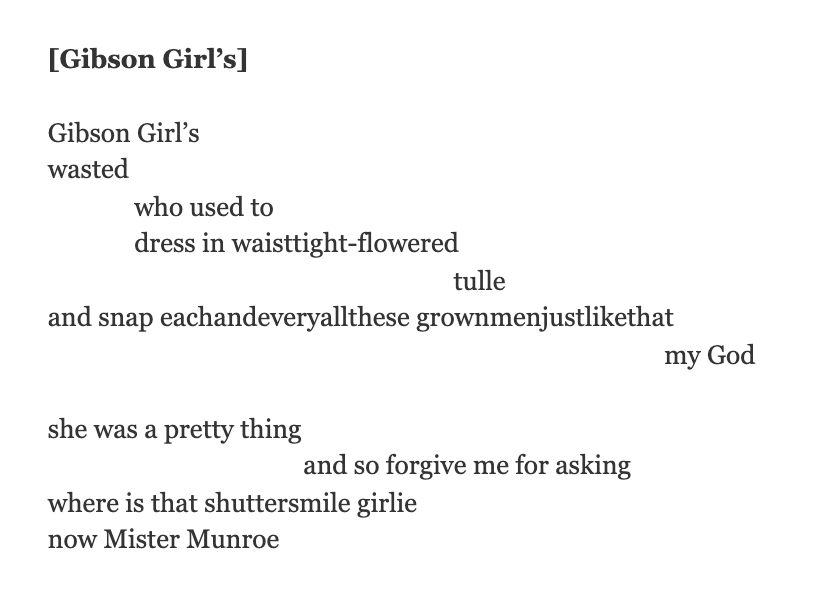
[Gibson Girl’s] is a pastiche poem I’ve written in the style of E. E. Cummings’ [Buffalo Bill’s]. I was stunned of sorts by the unique form, illuminating diction, and allusive imagery of the original poem, which I have tried to emulate in my own.
[Gibson Girl’s] speaks to the life of 1900s It girl Evelyn Nesbit, making reference to how her life was “wasted” in her marriage, foreshadowed by the alliterative “waisttight” dress of alluring elegance. Her beauty was enough to “snap” men as though they were playthings, but the word also references how her first husband, so enamored, “snap[ped]” and murdered the man he saw as his romantic rival.
When they eventually divorced, this husband left her with near nothing of his fortune in his will. The final question to “Mister Munroe” is a sardonic nod to the pseudonym her husband used when first pursuing her, where he deceived her of his true self and the misfortunes that would inevitably befall the girl he once so adored.
-
The Legacy of Gatsby
Biographical Information and Seminal Works
F. Scott Fitzgerald was born Francis Scott Key Fitzgerald, and lived from 1896 to 1940 as an essayist, screenwriter, short-story writer, and most famously, as a novelist. He fell in love with socialite Zelda Sayre, and they were eventually married.
During his lifetime, he finished four novels: This Side of Paradise, The Beautiful and Damned, The Great Gatsby, and Tender Is the Night, all of which achieved varying degrees of commercial and critical success. However, it may be surprising to know that some of his works only received critical acclaim after his death, and he died believing himself a failure because he never found more than moderate success in his life.
Expert Opinion
Milton R. Stern, a professor of literature who specialized in the works of Fitzgerald, quoted, “In the process of combining lyrical description with objective circumstance he mastered the connections between themes and narration.
“The expression itself grew from his remarkable power with evocative language”.
Additionally, according to Raymond Chandler, an American-British novelist and screenwriter, “Fitzgerald was above all, a storyteller who achieved a close relationship with the reader through the voice of his fiction, which was intimate, warm, and witty.
“He had one of the rarest qualities in all literature.”
Themes
Throughout Fitzgerald’s works, there are some recurrent and common themes.
A primary theme in Fitzgerald’s novels is the promise and failure of the American Dream. He believed in the American Dream of success and fulfillment because of his personal experiences, namely his growing up with a sense of being a poor boy in a rich man’s world, but also with a sense of having his own important destiny.
As an author, Fitzgerald expressed the ways the American Dream could be debased and distorted, in addition to how it could be fulfilled. His most reminiscent protagonists, including Jay Gatsby and Dick Diver, had the willingness of the heart defined by Fitzgerald as a quintessential American quality. While they are frequently disappointed by their pursuit of success, it is never the dream that fails them. Rather, some weakness or corruption, in themselves or in others, hinders them instead.
In The Great Gatsby, Gatsby’s hopeful dreams of wealth and love are anything but corrupt; however, as Nick Carraway says, it is “what preyed on Gatsby, what foul dust floated in the wake of his dreams” (6) that destroys him. The dust connotes Gatsby’s naiveté about the conflict between old and new money, and the adverse negligence of the Buchanans. In Tender is the Night, Dick Diver’s pursuit of the success and fulfillment of the American Dream is defeated by his weakness for wealth and the leisures that it can buy.
WEALTH AND MATERIALISM
Next, probably more than any author of his era, Fitzgerald was conscious of the influence of wealth on life and character. He often wrote about the lives of the rich upper class, but his awareness of money’s effects on character was complex. Some of his seminal works expertly reflect his attraction to and his simultaneous distrust of the rich.
In Fitzgerald’s eyes, money was also an important part of the American Dream. Not only did it provide luxuries and opulence, but money also opened up opportunities that were unavailable to less affluent people. He was greatly disappointed by the wealthy who wasted the opportunities that their money gave them, and also disapproved of those who perverted their privilege.
He explains these ideas in both The Great Gatsby and Tender Is the Night when he describes how “the Buchanan’s money makes them careless, hard and directionless” (10) and details how “Dick Diver has been swallowed up like a gigolo, and somehow permitted his arsenal to be locked up in the warren safety-deposit vaults” (209). Fitzgerald had a clear understanding that just as money has the potential to fulfill people who possess it, it has the power to corrupt them.
DISILLUSIONMENT OF LOVE
For Fitzgerald, one prominent life shaping experience was the romance and devastating misfortune of his relationship with Zelda Sayre. In fact, virtually all of his important female characters are a reflection of Zelda and his connection with her. The early stages of their relationship intensified Fitzgerald’s sense of being excluded from opportunities money provides, when Zelda initially rejected him because of his poor prospects.
His fictional treatment of the roles of love and money in his life is extensive and profound. Love can be powerful, passionate, and intense, but also has a way of being fleeting, fickle, and short-lived. In This Side of Paradise, Amory’s handsomeness and charisma attract many women, but although he yearns to be fulfilled by falling in love, he only finds himself increasingly heartbroken. When his fiancée Rosalind leaves him for another man who is only more wealthy, Amory descends into a spiral of despair. In The Great Gatsby, Gatsby reinvents himself entirely, believing he will be good enough for Daisy once he is wealthy. Unfortunately, his absolute devotion to her results in his demise, and she chooses another man who offers her a life secure in both wealth and society.
Style
Fitzgerald also utilizes many writing techniques to draw the reader in and create his own unique style. He uses imagery, diction, and symbolism to convey his message.
Fitzgerald uses an impressionistic writing style in all of his works, the details of which evoke mood. In The Great Gatsby, Nick Carraway starts his first description of one of Gatsby’s parties when he hears “music from my neighbor’s house through the summer nights. In his blue gardens men and girls came and went like moths among the whisperings and the champagne and the stars” (43). The diction and rhythm of these lines establish a romantic mood. Through the speaker’s narration, Fitzgerald employs diction that suggests both the magical and corrupt qualities that exist within the world of the novel.
Another primary element in Fitzgerald’s novels is symbolism. One specific example in The Great Gatsby is “the green light that burns all night the end of Daisy’s dock. This represents both Gatsby’s devotion to her and the dream she personifies for him. The green light is symbolic of not only Gatsby’s dreams, but also the grand American Dream that all readers presumably share.
We also identified various distinctive elements of Fitzgerald’s style, including his dramatic use of verbs. One example is in The Great Gatsby, when Nick describes Wilson’s car that “crouched in a dim corner” (25, Great Gatsby). There was also a clear pattern of linking adjectives that seem contradictory to create various antitheses. This is evident in Tender is the Night’s description of “Nicole Diver’s hard and lovely and pitiful face” (10). His use of incompatible nouns and adjectives produces thematically evocative effects: again in The Great Gatsby, the “triumphant hatboxes” (64) of Gatsby’s car and the “blue garden” (43) of his home both indicate the grandeur but unreality of how Gatsby sees himself.
Impact
Upon publication, Fitzgerald’s first novel This Side of Paradise sold more than fifty thousand copies. The instant commercial success was in large part because of the way Amory’s thwarted ambitions are depicted as generational dilemmas: his failures in love and university are not simply due to personal shortcomings, but are impacted by the sweeping changes of modern life, which quickly caused young people to grow up “to discover all gods dead, all wars fought, all faiths shaken” (260).
The novel gave a voice to the post WWI youth by offering a realistic portrait of adolescent estrangement. In doing so, Fitzgerald’s work established the template for later 20th-century coming-of-age novels, for example, J.D. Salinger’s The Catcher in the Rye and Slyvia Plath’s The Bell Jar. Fitzgerald also had impacts on Ernest Hemingway’s works, who was a longtime friend.
Timelessness
To me, F. Scott Fitzgerald is a great author.
Although his original audience was limited to a postwar generation with comparably vast societal differences between genders, Fitzgerald is still one of the most renowned authors of the 20th century because of his masterful use of language, complex characters and timeless themes. Many people still feel ostracized by a larger culture, bound by limitations they cannot understand and cannot escape. Class and accompanying opportunities continue to create disparities in society. Even today, growing up has many disillusions that phase the bravest of us.
After almost a century, love and wealth have not become any less attractive or corruptive, and we continue to grasp on whatever fleeting and great hopes they offer. Fitzgerald’s novels endure, generation after generation, because every time a reader returns, they discover new revelations, insights, and bits of language that light another spark within them.
-
The Panacean Review
This summer had been one of the most wonderful of my lives. I was with family, and sun, and literature. I met a friend during my summer program at Stanford. Her name is Erika and she lives in Hong Kong. We were one of the only ones not living in the States, joining at odd hours in the day. Her and I share a passion for writing and sharing. Her and I wanted to start something.
We have come together to launch a literary magazine, The Panacean Review. We want it to be a way for people to connect. Especially in these times, we want it to be a way for people to feel the hurt of writing, and heal. It is meant to be a spotlight on emotion and passion. A simulation of conversation and company absent from our lives in isolation.
This has been a project of long work. I hope I’ll have many more things to speak about in the months to come.
-
Dostoevsky on Morality
Dostoevsky: Life, Themes, and Style
Fyodor Mikhailovich Dostoevsky was born in Moscow in November of 1821 in Czarist Russia. He lost both his parents by the time he was 18, and began his literary career a few years afterwards. Dostoevsky married twice and had four children before his death in 1881.
While many of his early works fell into the Gothic and Romantic melodrama genres, the decade Dostoevsky spent in a Siberian labor camp and as a soldier in exile stripped his work of all its old soft dreaminess. His post-Siberian works were deeply philosophical and satirical, loaded with themes and symbolic characters drawn from his own life. He published tens of great works in his lifetime, but is most celebrated for his novels Crime and Punishment, The Idiot, Demons, and The Brothers Karamazov.
Many of his works deal with themes of “universal guilt, human alienation, the meaning of human suffering, and the limits of morality” (Rosefeldt). His characters are tormented individuals… torn between their sensual appetites and their longings for spiritual fulfillment” (Rosefeldt).
In addition, Dostoyesvky employs a unique narrative style in his works. He disregarded the mode of logically progressing, chronological narratives, and instead constructed plots as puzzles.
Dostoevsky also distinguished himself with his “carnivalistically exaggerated tone in describing or echoing the torments of members of the lower classes” (Frank). Their “emotional passions and personality quirks” create caricature-like portrayals that leave a jarring impression on the reader while enhancing the complexity of his literary expression (Frank).
Impact
The combination of Dostoyevsky’s relevant themes and unique style left a considerable impact on both society and the future of literature.
The nihilism and rationalism and related ideologies present in his works were sweeping across Europe, especially Russia. These ideologies represented the dangers of radical revolutionaries, and were philosophical precursors to the Russian Revolution. The literary argument between piety and skepticism also depicted the ideological conflict between the Church and skepticism of the upper class.
At the same time, Dostoyevsky’s style was leading Russian literature away from its black and white narratives to a more polyphonic plane. His plot form was largely uncharacteristic of his time, and he detailed subject matter uncommon for accepted literary norms. Some of his characters became archetypes in various genres of fiction, such as Crime and Punishment’s Raskolnikov for many modern criminals.
Critique
In a quote from the Critical Survey of Long Fiction, Margot K. Frank posits, “That Dostoevski is avidly read by the general public and specialists alike attests his genius in fusing banalities with profound intellectual insights”. Dostoevsky was hailed in Russia for his literary talent, and was also internationally renowned. His works have remained relevant across generations, and are studied today not only by literary critics and historians, but also by philosophers, psychologists, and theologians.
“Nevertheless,” Frank maintains, “a certain unevenness in language and structure remains.” Dostoevsky was one of the few great Russian novelists of his time not born into the upper-class gentry, and often needed to rush his works into publication in order to make money.
“The constant pressure under which Dostoevski worked resulted in incongruities and dead spots that are incompatible with expert literary craftsmanship. Some of these rough spots were edited out… but the sense of rugged style persists, and reading Dostoevski is therefore not a relaxing experience” (Frank).
My personal opinion on Dostoevsky is based on my reading of two of his novels: Crime and Punishment and The Brothers Karamazov. Crime and Punishment follows Raskolnikov as he plans, commits, and struggles with the aftermath of a murder he is unable to justify. The Brothers Karamazov revolves around three brothers who reunite, only for each to play a part in the murder of their father, and suffer the consequences.
The archetypes I recognized are still relevant in modern literature and relatable in the present world. Similarly, conflicts of the characters are identifiable in many works I’ve read across periods and genres, and are experienced by people in my own generation.
In a way, his works were also more palatable for me than other older pieces of literature. In form, both books I read were crime novels. The genre eased the interpretation of its substance, a psychologically complex subtext. Similar to the way parents might hide medicine in their children’s ice cream, Dostoevsky veils an incredibly detailed psychological and philosophical narrative in his novels built on plot machinations of exciting crime fiction.
Duality in The Brothers Karamazov and Crime and Punishment
The primary aspect I felt compelled to focus on was Dostoevsky’s brilliance in creating dichotomies between characters. They argue opposite sides so convincingly that it is impossible to form a simple judgment about either side. As a result of this duality, Dostoevsky was able to skillfully develop a significant, recurring theme in his works: rationalism.
In reality, rationalism was the antithesis of Dostoevky’s personal beliefs. So, Dostoevsky now had two options for presenting the argument for rationalism. His first option would be to create a straw man out of it; to caricature the perspective in order to make it as weak as possible, so it is easy to come up with an argument, destroy the straw man, and win. The second possibility would be to create an iron man; instead of making the opposition weak, it’s made as strong as possible before one’s own perspective is hit against it.
This is exactly what Dostoevsky does in his novels. And in The Brothers Karamazov, he does so through the second brother, Ivan Fyodorovich Karamazov.
From the beginning of the novel, Ivan is defined by his intellect. For this reason that makes him special, he is also unable to accept faith in God that comes easily to others like his brother Alexei, called Alyosha.
In the first part of the novel, Ivan is quoted as having written “‘Immortality of the soul does not exist, therefore there is no virtue, therefore everything is permitted’”. Without any incentive to get into heaven, Ivan sees no reason for moral obligation or limitation on human behavior.
In Part Two of the novel, Ivan argues to Alyosha that God would have harmony at the cost of innocent suffering, a price Ivan believes no one should have to pay. Ivan goes on to tell Alyosha a story he made up called the “Grand Inquisitor,” which ridicules human sacrifice and forgiveness in the name of Christ and claims the freedom gifted to humanity is a burden that real people, who cannot imitate the same goodness as Christ, are cursed to bear.
Thus, Dostoevsky excellently argues limitations of faith through Ivan’s conviction.
However, it later implicates Ivan in the murder of his own father Fyodor Karamazov. Smerdyakov took Ivan’s words that “everything is permitted” to heart and killed their father “because if there is no eternal God, then there is no virtue and, what’s more, absolutely no need for it.” While at first denying that he could have encouraged Smerdyakov to commit the crime, Ivan spirals into insanity as he questions his own fault. Ivan eventually succumbs entirely to his confusion, madness, and guilt, which Alyosha identifies as a result of his skepticism and an inability to accept truth.
In fact, Alyosha predicts the pain Ivan’s skepticism will bring in Part One of the novel, wondering from the beginning if “Perhaps it’s suffering he’s seeking”.
In Crime and Punishment, Dostoevsky creates another argument for rationalism through the novel’s protagonist, Rodion Romanovich Raskolnikov.
Raskolnikov is a former law student who dropped out when he could no longer afford it. While he’s dirt poor and half delirious, he is at the same time intelligent and incredibly proud. His sister Dunya is about to enter a loveless marriage in order to support her family. Raskolnikov has become acquainted with an wealthy old pawnbroker Alyona Ivanovna whom he describes as “useless, nasty, [and] pernicious”. To make matters worse, Alyona treats her intellectually impaired half-sister Lizaveta like a slave, taking her earnings, beating her, and emotionally abusing her.
At this point, Dostoevsky has created a situation where Raskolnikov has every good reason to commit murder. Philosophically, Raskolnikov believes he is elite to the point that normal moral standards no longer apply, where murder is justified when the life taken is less meaningful, and when it’s done for a higher purpose or greater good. Practically, the money he plans to steal from Alyona would help him go back to school, bring his family out of poverty, become a philanthropist, and save his sister from the altruistic prostitution of marrying for money. Ethically, killing Alyona would also save Lizaveta from her slave-like, pitiful life. Morally, since Alyona is awful and evil and hated, getting rid of her would be the right thing to do.
Yet despite all these reasonable justifications, the reality of his actions only worsen the situation. Raskolnikov loses any illusion of “eliteness” when he is consumed with guilt and horror, buries the money he stole under a rock without using any of it to help anyone, and never saves Lizaveta because he’s killed her for witnessing the murder of her sister.
The murders thrust Raskolnikov into mental anguish from his crime. He is racked with confusion and paranoia, and the generally well-meaning justifications become empty as Raskolnikov suffers the psychological and physical consequences.
Dostoevsky uses the identities of Ivan Karamazov and Rodion Raskolnikov to symbolize the rationalist idea. They each represent a composite group identity, through which Dostoevsky reveals the shared theme of The Brothers Karamazov and Crime and Punishment: that morality cannot always be justified by rational thinking.
Dostoevsky uses varied language, alternating long, winding sentences of internal monologue and clipped descriptions to control speed and tension in his stories. His style in tone and plot is unique and entirely engaging, and the themes and characters he presents in his works offer nuanced, philosophical interpretations of identity and ideologies. His works are heavily influenced by his life and European society in the 1800s, but are still widely read and learned by people today. Dostoevsky’s influence and genius are of a near matchless standard, and he has certainly proved to be a great author, and one of the most important figures in the history of the modern novel.
-
Summertime: Artist Statement
This post is the first in my series of Reflections on Summer. I had the opportunity to participate in Stanford Pre-Collegiate Summer Institutes’ Creative Nonfiction, Fiction, and Poetry course this July, and will be reflecting on my learning and rediscovered passion for writing.
In this post, I am sharing my artist statement as an overarching reflection of myself as a writer and my time over the summer.
Artist Statement
Ideas come in splashes, and writing is directing the tide. Authors write from little more than a flash of memory, or a brush of a hand, or a pang of emotion that pulls them into their past. No matter how small the splash of an idea is, taking the time to write is creating the river, the bed, and the entire sky above it. We use language to shape an idea, to examine, interact, and, to our best ability, explain the concrete systems, laws, and beliefs of our world. Each piece of writing is the product of affliction or experience, a product of impact of the world on the author. At the same time, each piece is the divisor of all of humanity, an equation in which we discover our values and morals.
A pen may be cut by a sword, but ideas can never be warped by force. Authors use language to sow and water the seeds, and place trust in their readers to be the reapers. The seeds can grow to be stems of revolt and rebellion; they can blossom into petals of revelation, or take in rays of light to set tradition ablaze. To write is to dare to take on the mysteries of the world, it’s infinite questions and infinite answers, in a finite life. It is courage that tests limits, a worthy opponent of strongly held beliefs sewn tightly into narrow mind, and an act with the power to kindle a flame and extinguish a wildfire all at once.
Of all the pieces I’ve written in this course, my favorite is the persona poem retitled “The Cracks in Your Faith” from the perspective of a rejected love letter. I wrote it with the purpose of creating a piece that encapsulates the dreams love instills in people, but also its ability to turn those desires to despair. Ultimately, I’m proud that I was able to connect elements of myth to a piece centered around a girl’s reality and her genuine emotions. I think it effectively created an otherworldly and almost ethereal portrayal of how the writer of the letter sees the addressee, Georgia.
In congruence with my favorite piece of work, my favorite genre to learn about and write in this course was poetry. Specifically, “The Cracks in Your Faith” gave me an entirely new experience writing within this genre that I hadn’t encountered before. Previously, I believed that writing poetry was easier than fiction because there were less rules regarding structure and syntax. However, I realize now that I never considered how each variation can give a line a different impact or meaning, and even serve to point the piece in a different direction. While I still believe poetry poses more opportunities to push creative boundaries in form and some stylistic elements, I also find greater satisfaction in reaching the balanced integration of structure, technique, and narrative in a way that effectively tells a story through the brevity of a poem.
Another piece I wrote during the course that was memorable for me was “A Story About Sarah”, a short story in which I examined the structure, history, and personal connections behind my name. It was fascinating, albeit at times disheartening, to learn the differences in my personal experiences from the religious and historical contexts in which my name was prominent. In connection to literature, in William Shakespeare’s Romeo and Juliet, Juliet claims that “a rose / By any other name would smell as sweet.” After writing this piece, I think Juliet fails to recognize the weight of a name and the meaning it holds. Names can be sources of pride and ties to our past; they can be gifts from loved ones or instruments of oppression. Writing this piece allowed me to analyze the value I place in my own name, and also recognize the importance it may hold for others.
Among the readings for this course, I was deeply impressed by Jamaica Kincaid’s “Girl”. Her critique of American society’s way of dictating what is and isn’t appropriate for women was insightful and stirring. Additionally, Kincaid clearly characterized the mother as harsh and hurtful, but also as someone who feels responsible for teaching her beloved daughter how to act to gain respect in the world. The use of imperative commands allowed me to directly compare the lessons the daughter in “Girl” is taught to the ones I have learned in my own life, and it pains me to know that there are many other girls who grow up belittled and pressured in similar ways as described in the story. The characterization of the relationship between the daughter and her mother was what most moved me, and overall, the piece was a thought-provoking examination of traditional gender roles in American society.
Above all else, I want my writing to have an impact. So, I will aim to write with purpose. I don’t want to write for the sake of filling up a page, but instead with the intention of sending a message, creating a person, or constructing a dream. With every piece, I want to emphasize the truths I recognize in our world that others may fail to see. Next, I will write often. There is no other way for me to continue practicing, experimenting, and growing as a writer if I’m not writing at all. Whenever I can, I will look around and within me, to my day, a conversation, or distant memory come to light, and I will write it so that others may understand them as well. Lastly, I will allow myself to be inspired by others. There are characters I have yet to meet and worlds I have yet to discover in writing, and there are few things so beautiful in life as wonderfully written works. I will remember the phrases, techniques, and moments that make a story memorable, and use them to reflect on and revise my own. Every person sees their own truth in the world; I would hope my writing lifts the blinds so that others may see mine.
-
A Blog for Girls Will Code
Girls Will Code’s main initiative has always been focused on encouraging young learners’ interest and pursuit of STEM related passions. To accomplish this goal, we have been dedicated to organizing new learning opportunities and pathways, as well as continuing to inspire young minds.
However, as a result of the pandemic, our team was faced with the challenge of staying connected to students, partners, and schools. With limited face-to-face interaction, we were forced to consider what that loss meant in terms of sharing with and learning from others outside the Girls Will Code organization.
Oftentimes, it is easy to think that writing and STEM are barely related. STEM is based on hypotheses and algorithms and scientific theories, all elements that have little meaning for traditional literature. However, words are also the way we came to learn this, and the way we continue to learn new things. They are the means through which we share developments and lessons and successes of people in the STEM world.
So, this month marks the start of my initiative for Girls Will Code: a blog!
Through this blog, I hope to bridge that disconnect between writing and STEM, and create a community centered around sharing outlooks and ideas in Girls Will Code. Our readers will be able to stay informed on our ongoing and upcoming projects, learn about new technological movements and discoveries, and also share their own stories in STEM. I am equally excited to share with our team’s own experiences with STEM, and the individuals behind the output on our social media and website. Additionally, there will be features on female leaders in STEM, online platforms for learning, and interesting career pathways.
Above all, I am most excited that I and Girls Will Code will have another way to stay connected and continue sharing with others.
-
The Case Against Reading
Decades ago, reading may have been a more popular pastime. Instead of getting speared off a horse or sewing for a family of ten, stories offered wonderful adventures from the comfort of one’s home. But today, unfortunately, reading seems to have earned itself a reputation for being boring—nowadays, anything reading can do, something else can do better. And here, I’ve collated a few of the main reasons why.
Case 1: The Visual Element
Compared to other forms of entertainment, there’s a clear difference in how visually engaging a book is (which in turn impacts how modern audiences take to reading). In 2019, the American publishing industry made about 15 billion dollars, whereas the film industry made over 100 billion. For the most part, it’s both easier and more enjoyable to sit back and let the story play out—and this is enabled by the entirely graphic element of film and other popular pastimes. And this may not be avoidable. Our biology already defines us as highly visual beings. Faces, colors, movement, and other visual cues maximize our interaction with and reactions to media, which reading lacks. Even means of entertainment perhaps once deemed “less interesting” have developed an appealing visual element, like music videos for title tracks or live videos for podcasts. Amidst this progress, reading seems to be the pastime that falls behind.
We often dismiss fixed images as less engaging than dynamic ones; but many times, the layers of a portrait we peel back carry more complexity than what’s acted out for us. And this is not to say illustrations cannot just be for aesthetic either: after all, we judge books by their covers before we know anything about them! Still, structure, form, and white space are all basic elements of poetry. Graphic novels, story books, and even regular novels can build on visual elements. Reading is only as disinteresting as we convince ourselves it to be.
Case 2: Immediacy
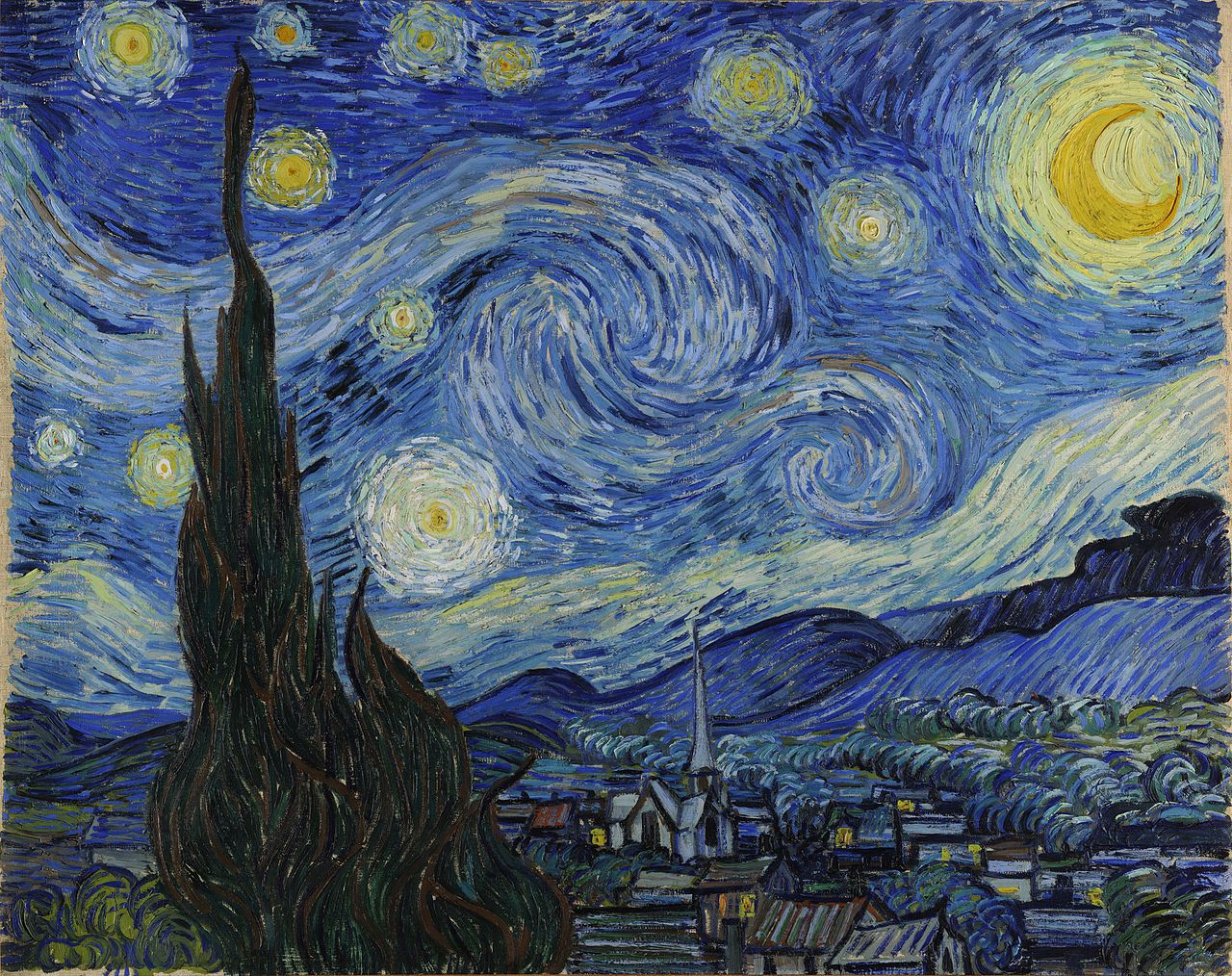
Vincent Van Gogh 1889, Starry Night 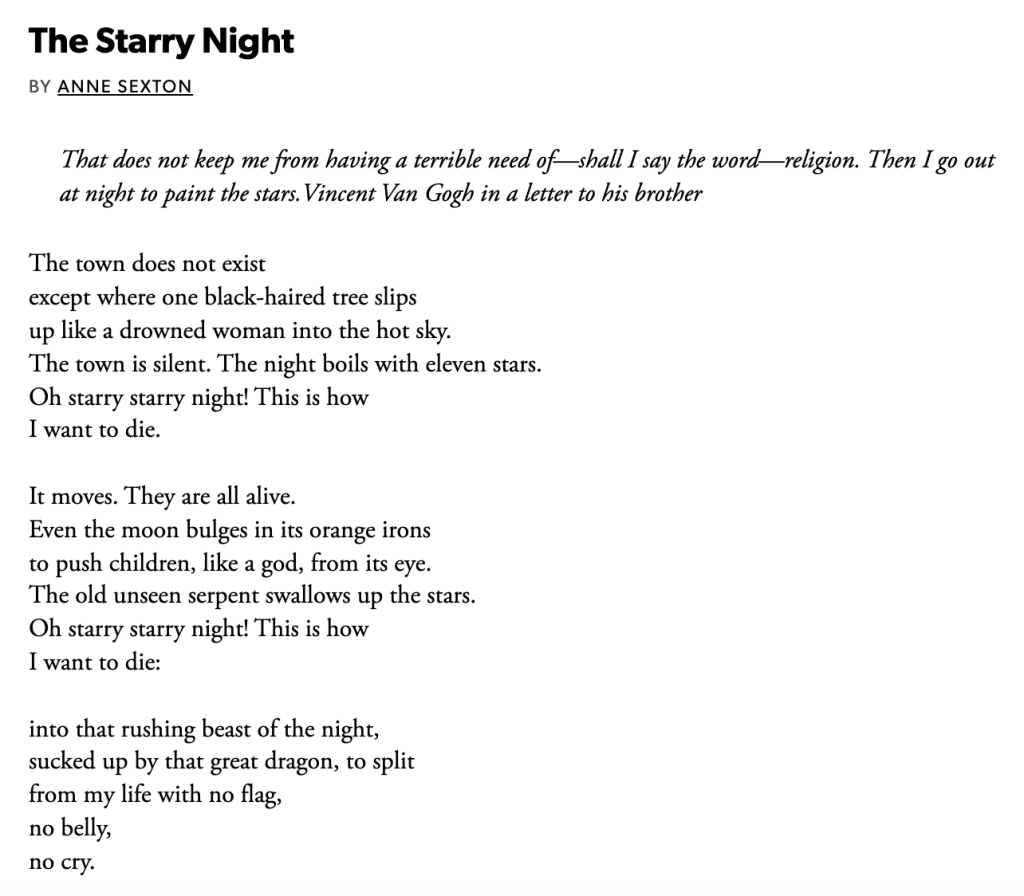
In this example, although both the painting and poem convey the same thing, we can process one almost instantly, while the other takes significantly longer. As entertainment grows shorter and shorter, reading begins to seem overtly time-consuming in comparison. Similar to reading, visual art has traditionally had a reputation for being a niche interest. But unlike reading, art can still have the same instantaneous effect on people as some more exhilarating activities do.
It would be unfair and untrue to argue that we can process writing as quickly as these other forms of entertainment; but it raises the question of what gives art its value. No matter how much or how little time it takes, I believe art is determined least of all by its length and most of all by our perspective: how we interpret it, how it can be interpreted in different ways, how it changes our perspective of other aspects of the world. Quick fixes are rarely the answer, and reading allows us to explore narratives in their purest, fullest form.
Case 3: Focus
Nowadays, much of the entertainment we enjoy is relatively easy to understand. I don’t mean this to take away from the complexity of some modern works; there are certainly nuances, themes, and other elements that are not obvious to audiences, even those who give their full attention to what they are taking in. But still, sensory elements generally make other forms of entertainment easier to understand and interpret. They don’t require all of our attention to create an experience or give us a feeling; we don’t need to give up everything else we’re doing to enjoy it. Books, on the other hand, are based on a single medium: words. Each word is part of the construction of smaller ideas, and these make up the entire story. And following that story requires continued focus. Working on something else, or even just looking away for a moment, breaks the magic of the experience.
For anyone in school, or with a job, with a family, with another hobby they already love, it’s not always easy to make time for these periods of focus. But if the problem is not being able to look away… why not listen? Audiobooks don’t necessarily make writing easier to understand, but books have a new appeal when you can better accommodate them into your lifestyle. If audiobooks are not for your taste either, you could consider poetry, short stories, or novellas. Finishing full length novels or epics can seem like a task that’s grand or looming. Shorter works can offer the same insight, pleasure, or whatever else you hope to gain from reading that longer works do; and sometimes, in less than half the time.
Case 4: Misconception
Not all books are the same. As I write this, I think this may be too obvious a thing to say. But people forget all the time. From what I’ve seen, so many people think reading isn’t for them because of a misrepresented first impression. Maybe it was required reading from school, or a bad run-in with an old classic. But there’s more to literature than old books! Some books are acclaimed, or classics, or important, and are widely read because of that; but you don’t really need to read for any other reason than yourself. There’s books of different reading levels, by different authors from different places who write in different styles about different themes: there are thousands and thousands of options to choose from. Even if you feel like you’ve already tried everything out there, I would still beg you to keep trying still; you never know what you may find.
Case 5: Interest
There are plenty of things I don’t care much about. For that same reason, there are a number of things I wouldn’t care to read about either. But I wonder how many people have missed the chance to read books about things they really cared about. Authors often write from experience, about their interests or upbringing or environment; when we have nothing in common or no interest in a book’s topic, it’s difficult to imagine that we’d be able to enjoy it.
When you’re choosing a new book, ask yourself first what you like. What’s fun for you? What do you want to learn more about? Similar to the last point on misconceptions about reading, we shouldn’t forget that books are incredibly diverse. It’s not always easy to associate reading with something fun, but the same way we spend our free time watching or doing things we like, there are sure to be books we can read about the things we love!
While I’ve just tried to convince you otherwise, there’s plenty of reasons why reading is not fun. There’s plenty of people who dislike reading, and I’m sure they each have plenty more reasons to explain why they dislike it. But my hope is, after reading this post, there’ll be a few more who’d like to pick up another book, and give it another try.

-
Subscribe
Subscribed
Have a WordPress.com account? Log in now.

