In the first week of my internship with RH Korea, I have worked myself a trail of translations: story books, chapter books, poetry, emails. We use language so unconsciously in every other thing we do, but in trying to contextualize meaning in another tongue, language has become enigmatic.
Here are my attempts to pick language apart and piece it back together; and my road to abandoning this method and finding a new source of inspiration altogether.
stage 1: story books
My editor told me very pointedly: translation is not word for word, it is by effect. In one recently released story book, a rabbit finds a magical pogo stick, and garners the catchphrase:
콩! 콩! 콩!
The phrase is onomatopoeic in Korean. It encapsulates the sound of the pogo stick bouncing off the ground, and the action of it. There is no direct translation into English. My solution was:
Hop! Hop! Hop!
It preserves the rhythm; the childlike familiarity; the simplicity. A part of me despairs, nevertheless, that I cannot construe everything about a “콩” in an English phrase. But there is a way, always.
stage 2: poetry
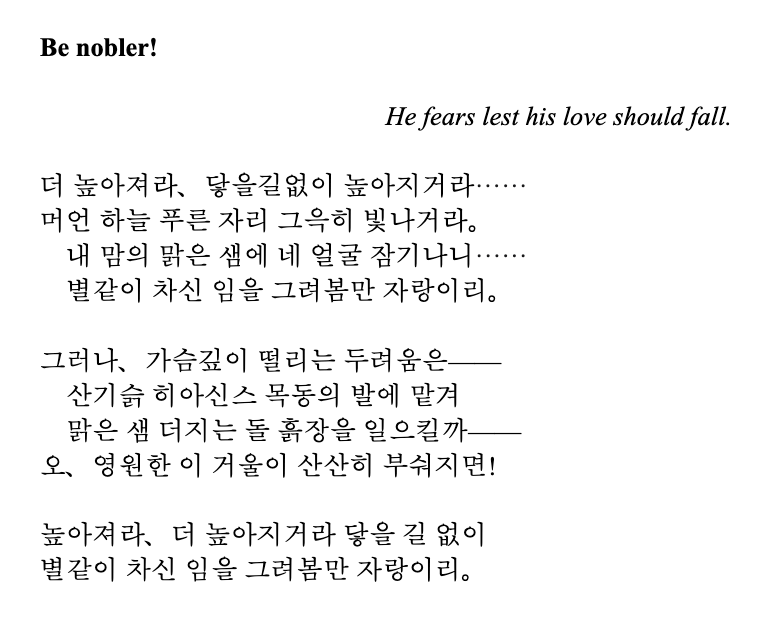
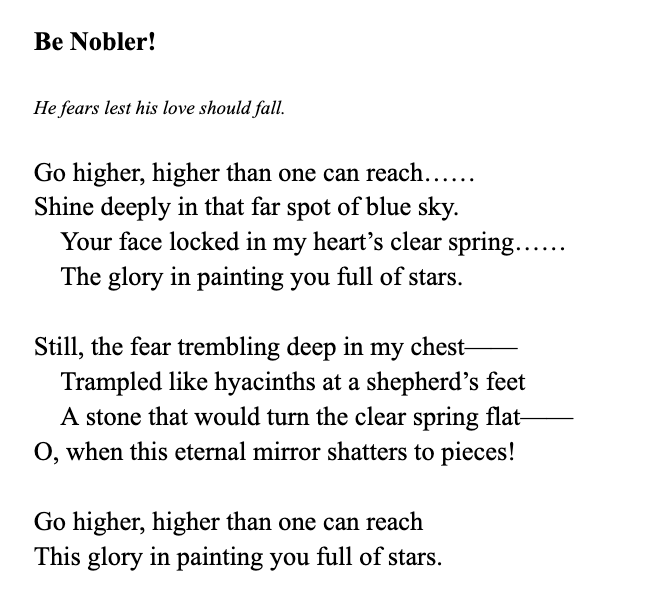
The translation of this one of my great-grandfather’s poems began with less authorly-intuition and much more dictionary referrals. It was immediately easy to tell that it was not a poem. A poem has essence; it has soul. It takes on a life of its own in being written and read, and every direct translation was slowly but surely strangling the poem dry. The result of maintaining this essence could be perceived as inaccurate. But in every sense, I believe it is much more true.
stage 3: creation
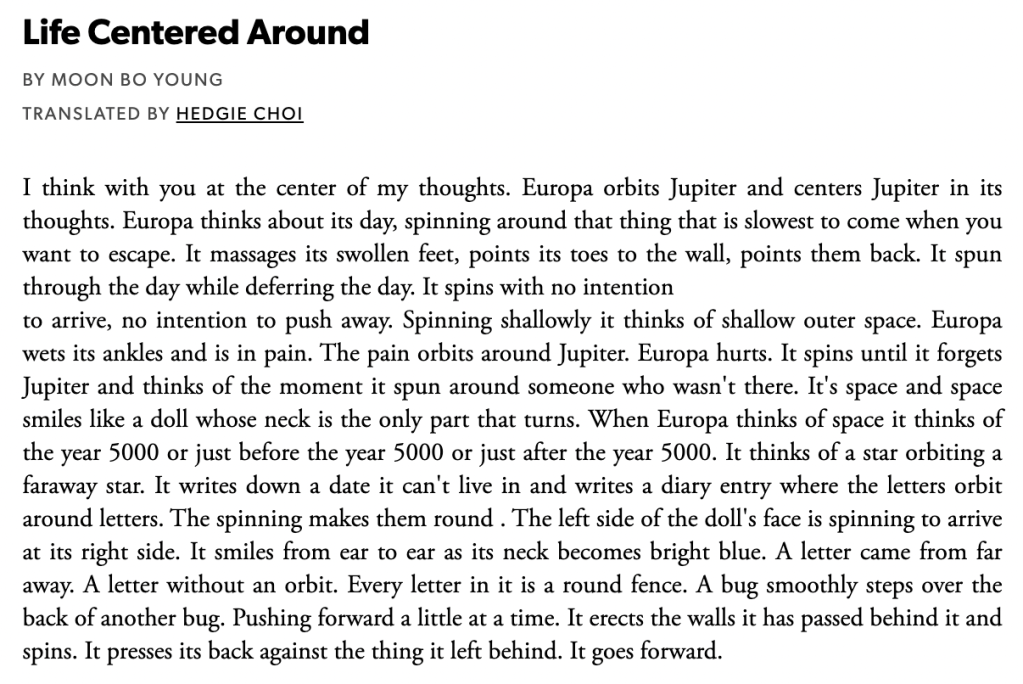
In one of my aimless wandering of the Poetry Foundation archives, I came across this poem. In all my first three readings, I did not realize that this was a translation. There is no hint of hesitance; no drop of fluency. I knew then, without having to have read the original, that Korean cannot read like this, literally. It cannot mean these things. Cannot say these things exactly. The parallelism and anadiplosis Hedgie Choi brings to the very first two lines — “I think with you at the center of my thoughts. Europa orbits Jupiter and centers Jupiter in its thoughts” — is already impossible to replicate with literary aesthetics in Korean. She has very well created a poem of its own. A poem that is the same as its original and yet nothing alike. A child bound by a random string of evolutionary chance, raised by strangers.
 Eye to the Glass